
From the field
9 rules for Driving in Sand
2 March 2026
9 Rules for Driving in Sand
Or: how not to bury your vehicle up to the diffs while pretending everything is fine
Driving in sand is one of those things that looks easy when somebody else is doing it.
You see a bakkie floating over a dune, tyres gently ballooned out, driver looking relaxed, probably with one hand on the wheel and the other reaching for a packet of biltong. You think: how hard can it be?
Then you try it yourself and, three minutes later, your vehicle is sitting on its belly, your tyres are digging to Australia, the children have learned two new swear words, and someone is standing outside with a spade saying, “Just go forward slowly,” which is almost always the worst advice available.
Sand is not tar. Sand is not gravel. Sand is a soft, shifting, treacherous thing that will punish arrogance faster than a border official with a stamp pad and no sense of humour.
The good news is that sand driving is not witchcraft. It is mostly about tyre pressure, momentum, smooth inputs and knowing when to stop making things worse.
Here are nine rules worth remembering before you point your vehicle at the soft stuff.
1. Don’t think sand driving is going to be easy
The first mistake is arriving with confidence.
Confidence is wonderful. Overconfidence is how you end up digging out a two-ton vehicle with a plastic beach spade while your friends take photos “for safety reasons”.
Sand driving feels strange at first because the vehicle behaves differently. The steering can feel vague, the engine works harder, and everything happens with a slight delay. You are not driving on the surface as much as you are trying to float across it.
That means you need to be awake. Read the terrain. Look ahead. Watch for darker, softer patches. Notice where other vehicles have been bogged down. If a track looks churned up, badly rutted or suspiciously innocent, assume it is planning something.
Sand rewards calm drivers. It does not reward people who arrive like they are auditioning for Dakar.
2. Reduce your tyre pressure
This is the golden rule.
Lowering your tyre pressure gives the tyre a bigger footprint, which helps the vehicle float over the sand instead of slicing down into it like a hot knife through butter.
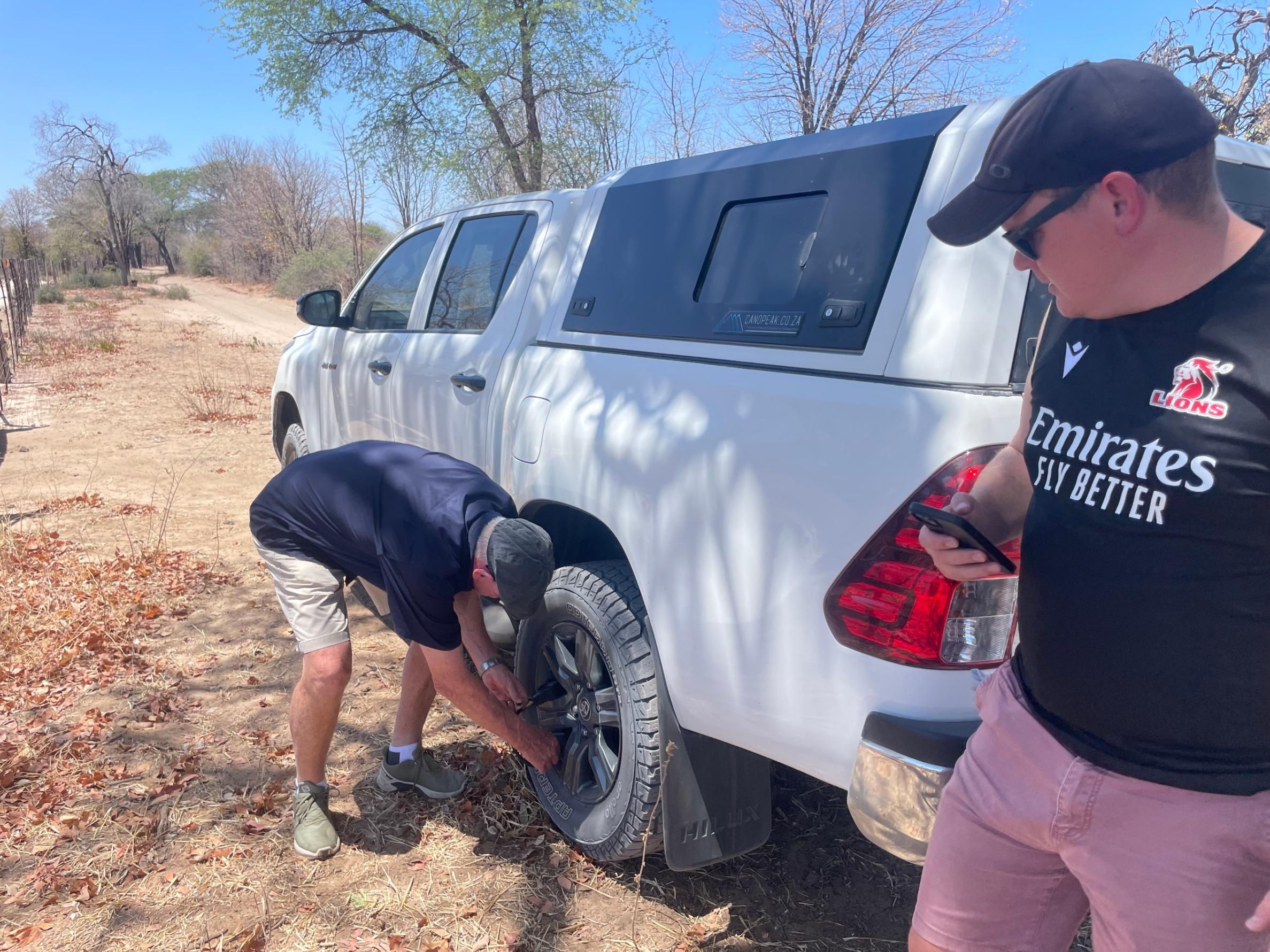
Even experienced drivers sometimes get this wrong. As mentioned above, overconfidence is not advisable. On a recent trip to Lake Sibaya, we were too lazy to deflate and then re-inflate the tyres properly.
Brilliant plan.
We struggled to get anywhere.
It was silly, avoidable, and luckily we did not get properly stuck, but it was a good reminder that sand does not care how much experience you think you have. It only cares whether your tyres are at the right pressure.
Think of it like this: a person in stilettos sinks into soft sand. A person wearing takkies does better. A person on a snowboard floats. Your tyres want to become the snowboard.
There is no single perfect pressure for every vehicle, tyre, load and sand condition, but as a broad guide many people start somewhere around 1.6 to 1.8 bar for general sand driving. In very soft sand, you may need to go lower, but that comes with extra risk. The lower you go, the easier it is to damage a tyre or pop it off the rim if you drive too fast, turn too sharply, or behave like a clown.
The key is simple: deflate before you are stuck, not after you have already buried yourself like a fossil.
3. Carry a proper tyre pressure gauge
Do not guess your tyre pressure by kicking the tyre.
This is not 1974 and you are not a farm uncle with supernatural sidewall-reading abilities.
Carry a proper, calibrated tyre pressure gauge and know how to use it. Many cheap gauges are about as accurate as a weather forecast for Mozambique in cyclone season, so buy something decent and keep it in the vehicle.
You should also carry a deflator if you plan to do this often. It makes the process quicker, cleaner and less likely to involve you crouching in the sand for 20 minutes while everyone else suddenly remembers they “need to check something at the cooler box”.
And while we are here: do all four tyres. Yes, even the back ones. No, the vehicle does not magically know you were in a hurry.
4. Keep momentum
Momentum is your friend.
Not speed. Momentum.
There is a difference.
Speed is arriving at soft sand like a hero and then launching everyone’s snacks into the footwell. Momentum is keeping the vehicle moving smoothly, without spinning the wheels, bogging down or making sudden dramatic decisions.
In sand, you want steady progress. Choose a suitable gear, keep your revs in a useful range, and avoid stopping unless you have a firm patch or a plan. Once you stop in soft sand, getting going again can be the beginning of a very sweaty afternoon.
The trick is to keep the vehicle moving without fighting the sand. Let it work. Keep it smooth. Keep it calm.
If you feel the vehicle starting to labour, do not immediately floor it. Spinning wheels usually dig holes. Holes become trenches. Trenches become stories your friends tell at braais for the next eight years.
5. Pick the right gear before you need it
Sand is not the place to be indecisive.
If you are approaching a soft patch, a dune, a sandy climb or anything that looks like it might become interesting, choose your gear before you get there. Changing gears halfway through a soft section can kill your momentum at exactly the wrong time.
In a manual, that means selecting the gear that gives you enough power without forcing you to shift halfway up. In an automatic, it may mean using the appropriate off-road mode, locking out higher gears, or using manual selection if your vehicle allows it.
The point is not to charge at everything like your mother-in-law is chasing you. The point is to prepare early.
Sand likes commitment. Not stupidity. Commitment.
There is a fine line, and it is usually marked by a recovery strap.
6. Don’t turn too sharply
Sharp turns in sand are a brilliant way to stop moving.
When you turn sharply, the front tyres start pushing sand instead of rolling over it. The vehicle slows down, the engine works harder, and the sand begins quietly preparing your grave.
Keep your steering inputs gentle and wide. Plan your turns early. Avoid sudden movements. If you need to turn around, do it in a broad arc where possible, not with a dramatic three-point turn in the softest patch you can find.
Also remember that a heavily loaded vehicle will behave differently. Add camping gear, water, fuel, food, children, firewood, a cooler box and that one bag nobody claims ownership of, and suddenly your vehicle has the turning grace of a pregnant hippo.
Give yourself space.
7. Be gentle on the brakes
Brakes are useful things. In sand, they can also be sneaky little saboteurs.
Hard braking digs the tyres into the sand and builds a small wall in front of them. That wall then becomes the thing you need to drive over when you want to move again. Congratulations, you have created your own obstacle.
Rather ease off the throttle early and let the sand slow you down naturally. It is very good at that. Too good, actually.
In soft sand, brakes are almost overrated. Use them when you genuinely need to stop immediately, not every time your foot gets bored.
When you do need to brake, do it gently. Smoothly. Like a person who has nothing to prove.
This is especially important when travelling in convoy. Leave more space than you think you need. The vehicle in front might stop suddenly, bog down, or make a poor life choice. You do not want to stop in the same bad patch just because you were following too closely.
That is how one stuck vehicle becomes a group activity.
8. Sometimes you need to go back to go forward
This sounds wrong, but it is one of the most useful sand-driving lessons.
If you feel the vehicle getting stuck, stop early. Do not keep burying the throttle while shouting encouraging things at the dashboard. You are not motivating the vehicle. You are digging.
Often, the best move is to reverse gently back along your own tracks. Your tracks are already compacted, which gives you a better chance of getting moving again. Back up, reassess, and try again with a bit more momentum, a better line, or lower tyre pressures.
This is not failure. This is intelligence wearing dusty shoes.
The real failure is sitting on the chassis rails, wheels spinning freely, while someone says, “Maybe try low range?” as if you have not already entered a deeply personal relationship with low range.
Stop early. Reverse if you can. Build a little runway. Try again properly.
9. Re-inflate as soon as possible
Deflated tyres are great in sand.
They are not great on tar.
Once you are back on firm ground, re-inflate your tyres as soon as possible. Driving too far or too fast on low pressures can overheat the tyres, damage the sidewalls, affect handling and generally turn your relaxing weekend into an expensive lesson.
Carry a decent compressor. Not a toy compressor that sounds like an angry mosquito and takes 45 minutes to inflate one tyre while quietly melting itself. Get something that can actually do the job.
We have also recently started using an IndeFlate system, which allows you to deflate or inflate two tyres at a time. It is one of those tools you do not strictly need until you use it once, and then suddenly doing one tyre at a time feels like sending individual WhatsApps instead of using a group.
It is also handy in a bind, because you can use it to balance pressures between tyres or, in an emergency, “borrow” some air from other tyres to get one low tyre back to a more usable pressure. Not a substitute for a compressor, but a very useful bit of kit to have in the vehicle.
Re-inflating is part of the process. It is not optional admin. It is what gets you home without wobbling down the road like a shopping trolley with one bad wheel.
Also remember to check your pressures again when the tyres are cool, especially after a long sandy section. Heat changes pressure readings, and guesswork is how problems sneak in.
Final thoughts
Sand driving is not about being brave. It is about being smooth.
Lower your tyre pressures. Keep momentum. Avoid sharp turns. Be gentle with the brakes. Choose your gear early. Stop before you dig yourself into a swimming pool. And, most importantly, leave the ego at home.
Because sand does not care how much your vehicle cost. It does not care how many accessories are bolted to it. It does not care that you watched three YouTube videos the night before and now consider yourself “basically experienced”.
Sand only cares about physics.
Respect it, and it becomes one of the best ways to travel. Ignore it, and you will spend the afternoon sweating, digging and pretending this was all part of the adventure.
Which, to be fair, it probably was.
But still. Deflate your tyres.