From the field
iMfolozi Guided Bush Trail: Day 1 — Leaving the Vehicle Behind
A supported walking trail into the iMfolozi Wilderness Area, where the vehicle gets left behind and the bush suddenly feels a lot closer. Day 1 takes us from Mpila into a temporary tented camp, with donkey bags, dome tents, bucket showers, warm beer, proper guides and the small but important reminder that wilderness does not care about your itinerary. Useful, honest, slightly sweaty, and absolutely worth doing.
12 March 2026
iMfolozi Guided Bush Trail: Day 1 — Leaving the Vehicle Behind
A supported walking trail into the iMfolozi Wilderness Area, with donkeys, dome tents, bucket showers and beer that tried its best.
There are a few ways to experience iMfolozi on foot. You can do a short guided day walk from camp, you can do a supported wilderness trail where most of the camp gear is transported for you, or you can go full primitive and carry your life on your back while sleeping under the stars like a person who has made some strong choices.
We did the middle option: the supported Guided Bush Trail / Short Wilderness Trail style experience.
In plain English, that means you walk from the main camp area into a temporary bush camp, spend two nights in dome tents, eat proper cooked food, wash under a bucket shower, and then walk back with a smug little look on your face because you have now officially done a wilderness trail.
This is not a luxury safari. Nobody is bringing you a gin and tonic on a silver tray while calling you sir. It is, however, one of the best ways I have experienced the bush.
You hear more. You smell more. You see fewer animals in total numbers, but somehow feel much closer to everything. Also, once you have had to consider whether a leopard might judge you during a toilet trip, normal life does feel a bit dull afterwards.
Quick trail notes before you pack the entire garage
Trail type
Supported wilderness trail. You carry a daypack; most food and camp gear goes in by donkey / mule support.
Typical format
Two nights in a temporary tented bush camp, with walks each day. Other iMfolozi trail formats range from base-camp comfort to primitive sleep-under-the-stars options.
Fitness
You do not need to be an Ironman, but you should be able to walk roughly 7–10 km in warm Zululand conditions without needing to be medically reconstructed.
Group size
Trails are small. The supported trails generally run with a minimum group and a maximum of about eight guests.
Included
Guides, meals, water, basic bedding / mattress, tented bush camp setup and camp support.
Not included
Park conservation fees, drinks beyond the basics, snacks, personal items, and usually your accommodation at Mpila the night before.
Ablutions
Bucket shower under a tree. Toilet system: shovel, paper, dignity, and a quick prayer.
Best mindset
Leave the “Big Five checklist” attitude at home. This is about being inside the bush, not ticking off animals like groceries.
What does it cost?
Ezemvelo tariffs change, so always check the live booking system before you publish, pay, or shout at anyone at reception. For the 2025/2026 tariff sheet, the supported iMfolozi wilderness trail prices are listed as follows:
Trail Base rate / minimum group Approx. rate per person
Short Trail — 2 nights R13,400 minimum 4 pax R3,350 pp
Extended Short Trail — 3 nights R21,000 minimum 4 pax R5,250 pp
Base Camp Trail — 3 nights R21,400 minimum 4 pax R5,350 pp
Primitive Trail — 3 nights R13,800 minimum 4 pax R3,450 pp
Primitive Trail — 4 nights R16,400 minimum 4 pax R4,100 pp
Explorer Trail — 4 nights R17,600 minimum 4 pax R4,400 pp
Important: the trail tariff excludes the Hluhluwe-iMfolozi conservation fee.
The 2025/2026 Ezemvelo tariff sheet lists Hluhluwe-iMfolozi conservation fees for overnight visitors at R300 per adult per day, or R150 per person per day for South African and SADC residents with proof of identity. Children under 12 are listed at R150 per day, with applicable resident discounts.
In normal human language: budget for the trail fee, your park conservation fees, your night at Mpila before the trail, fuel, snacks, and enough beer to test the limits of warm beverage optimism.
Arriving at Mpila
We stayed at Mpila the afternoon before the walk, and honestly, that is the better plan.
You do not want to arrive late, repack your donkey bag in a panic, realise you brought three head torches but no underwear, and then start a wilderness trail the next morning already mentally damaged.
Mpila is the main rest camp in the iMfolozi section of Hluhluwe-iMfolozi Park, and it has that proper old-school KZN bush feel. It is unfenced, raw around the edges, and exactly why I like it. You are not sealed away from the bush. The bush is right there, occasionally rummaging under your raised tent platform while you are trying to braai.
We arrived the afternoon before the trail, collected our donkey bags at reception, checked into our safari tent and started the highly technical process of deciding what was essential.
Clean socks? Yes.
Third pair of shoes? No.
Emergency snacks? Obviously.
Beer? Now we are asking the right questions.
That evening, while the fire was doing what fires do and men were standing around it pretending to be useful, we were entertained by hyenas and bushpigs moving around below the raised safari tents.
It is a brilliant experience, but also a useful reminder: this is not a petting zoo. Enjoy them, photograph them, and do not become the person who makes everyone else sit through another safety briefing because you wanted to touch a hyena.
The packing reality
Before you even start walking, the trail teaches you its first lesson: you probably brought too much stuff.
Your main bag goes into what they call a donkey bag. Think army-style duffel bag. It is not there for your emotional baggage or your full wardrobe. Clothes, toiletries and whatever personal comforts you are bringing need to fit in there.
Pack like a grown-up, not like someone preparing for a fashion show in the wilderness.
You will still need a daypack. In that daypack you carry water, snacks, binoculars, camera gear, sunscreen and anything else you may need during the walk.
Get a proper hiking-style pack if you can. Lumbar support sounds like a boring adult problem until you are halfway up a Zululand hill and your shoulders are filing a formal complaint.
Shoes matter. Comfortable, worn-in walking shoes are non-negotiable. This is not the place to test a new pair of boots unless you enjoy blisters and regret.
Neutral-coloured clothing is best: khaki, olive, brown, grey. Avoid white, red, yellow and anything that makes you look like a walking Checkers packet.
The safety briefing and the river that had other plans
The next morning we went to the safety briefing.
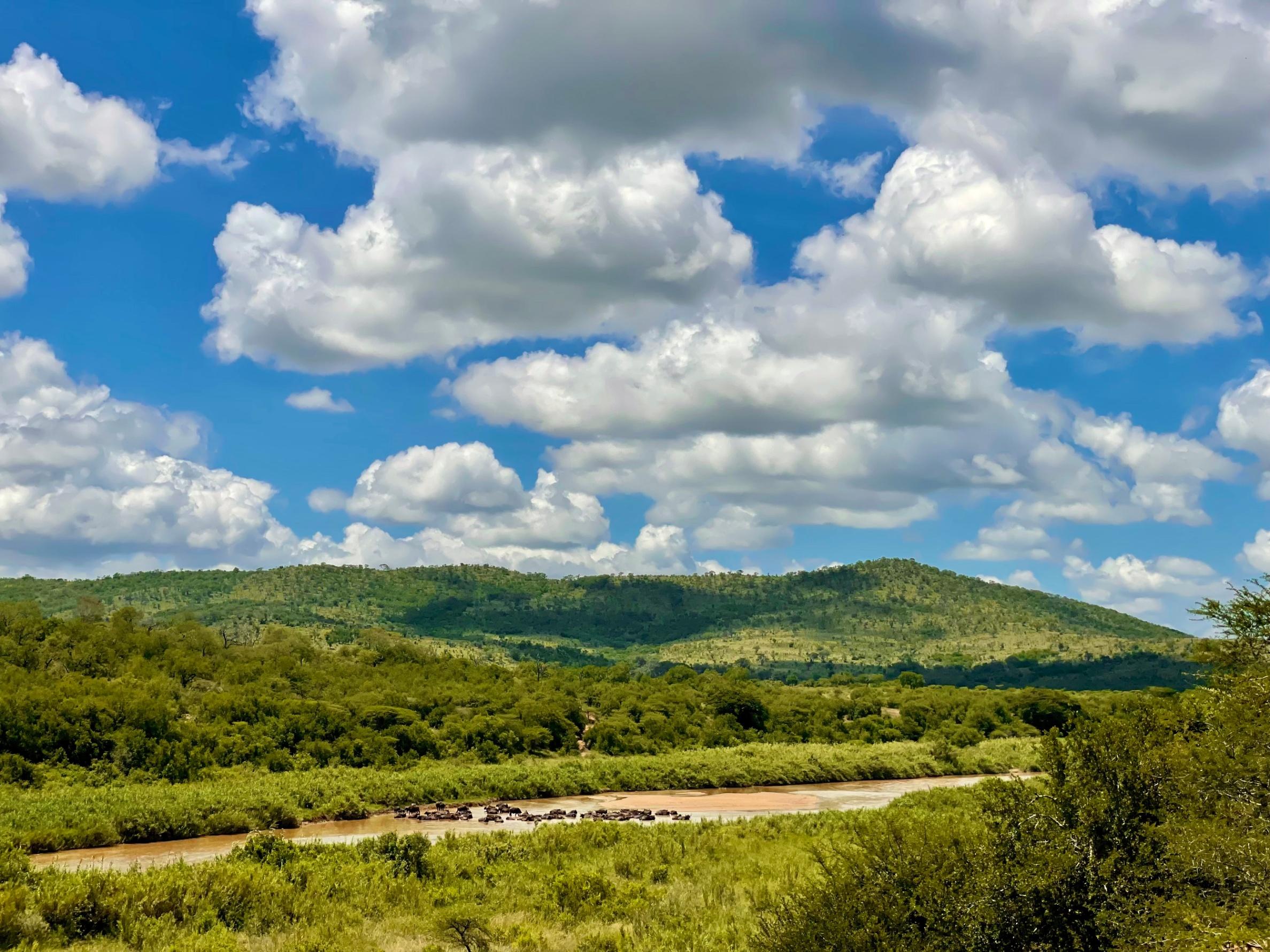
Normally, the route starts from one of the bush camps, crosses the Black iMfolozi River into the wilderness area, and then winds its way towards the temporary camp.
On our trip, the river was too high, so the plan changed.
That is worth remembering: this is wilderness, not a theme park. Rivers, weather and animals do not care what your itinerary says.
Instead of crossing the river, we were taken by safari vehicle to a safer starting point. The guides explained the walking rules: stay together, listen immediately, do not wander off, do not shout, and when the guide says stop, you stop.
Not after one more photo.
Not after finishing your biltong.
Stop means stop.
There are armed guides for a reason, and that reason is not decoration.
The walk into camp
The first walk was not brutally strenuous, but this is Zululand, and Zululand has a way of reminding you that shade is a privilege, not a right.
The pace was relaxed and there were regular stops, but you still need enough water. Bring more than you think you will need. Dehydration is a rubbish personality trait.
At one point we stopped on a cliff overlooking the river, and there were some of the most impressive spekboom I have ever seen. Proper old giants, with trunks thick enough to make you stop and stare.
The guide explained how their position on the cliffs protected them from regular browsing. In a vehicle, I would probably have driven past that completely. On foot, you start noticing the smaller stories.
That is where these trails really work their magic.
From there it was mostly downhill, which every person immediately pretends not to be grateful for while secretly thanking every ancestor they have.
We reached camp at around 14:00 and settled into the dome tents. Basic, comfortable enough, and exactly what you need.
This is not about Egyptian cotton sheets. This is about falling asleep in a tent while the bush carries on with its night shift outside.
The cold beer problem
Our camp was apparently set a little further from the river than usual.
These temporary camps are moved to avoid lasting impact on the environment, and they are set up with the lightest practical footprint. This is excellent conservation practice.
It is also terrible news for beer refrigeration.
Normally, the more experienced trail philosophers dig a hole in the damp sand near the river and bury the beers there to keep them cool. Since we were not close enough to the river, we had to improvise with a wet towel.
Did it help? Technically yes.
Were the beers cold? Absolutely not.
They were emotionally supported at best.
Luckily, the first warm beer is the worst. By the second one your standards have adjusted, and by the third you start telling people that this is actually how beer was intended to be enjoyed by the ancestors.
It was not, but the bush does strange things to a man.
The afternoon walk
After settling in, we headed out again for a short late-afternoon walk, maybe around 4 km along the river.
Game viewing on foot is completely different to game viewing from a vehicle. You usually see fewer animals, but the encounters feel more earned.
You are also far more aware of wind, tracks, dung, alarm calls and every mysterious rustle that instantly turns you into a professional wildlife analyst with no qualifications.
This is also where good guides make the experience.
Birds, trees, insects, spoor, browse lines, animal behaviour — suddenly everything has a story. You realise the bush is not empty between sightings. It is busy all the time; you are normally just too distracted by looking for lions to notice.
By the time we returned to camp, that lukewarm beer had become less of a problem and more of a reward.
Funny how quickly standards collapse when you have earned something.
Dinner, bucket showers and the wilderness toilet
Dinner was prepared by the camp chef, and we ate around the fire while the bush started settling into the night.
That sentence sounds romantic because it is.
It is also the part of the day where everyone becomes quiet for a while, which is rare and should be respected. No signal, no scrolling, no nonsense. Just firelight, food and the sound of the bush doing bush things.
Then came ablutions.
The shower is a bucket shower hanging from a tree, filled with warm water. It works surprisingly well, provided you do not expect a spa experience or start asking where the heated towel rail is.
You wash, you feel human again, and you become grateful for things you normally take for granted.
The toilet setup is even more honest: there is no toilet.
There is a shovel, toilet paper and a designated area of bush. You dig, you do what needs doing, and you cover it properly.
At night, one of the rangers has to accompany you. They keep a gentlemanly distance, but they are there because wandering into Big Five country alone at night for a bathroom break is not bravery.
It is paperwork waiting to happen.
Final thoughts from Day 1
Day 1 was the perfect introduction: enough walking to feel like you had done something, enough comfort to keep morale intact, and enough wilderness to remind you that you are a guest here.
Not the main character.
A guest.
If you are expecting constant dramatic animal sightings, you may miss the point. If you are willing to slow down, listen, learn and accept that warm beer sometimes happens to good people, this trail is exceptional.
We went to bed clean enough, fed properly and slightly more respectful of the bush than we were that morning.
Day 2 would be longer, and we needed the rest.
Also, nobody wants to be the person holding up a wilderness trail because they treated the first night like a bachelor party with hyenas.
Practical notes for booking
Book through Ezemvelo KZN Wildlife or a reputable operator that confirms the exact trail type, date, inclusions and conservation-fee treatment.
Confirm whether the trail departs from Mpila / Mdindini, where you must park, and whether you need accommodation the night before.
Ask about dietary requirements when booking. Some trail formats can accommodate them better than others.
Take malaria advice from your doctor or travel clinic. This area is generally treated as a malaria-risk area, especially in the warmer months.
Pack neutral clothes, a headlamp, spare batteries, binoculars, sunscreen, a hat, insect repellent, biodegradable soap, water bottles / hydration bladder, and a dry bag for personal items.
Do not overpack. The donkey bag is not a portal into another dimension.