From the field
iMfolozi - Where Kings once hunted
A personal introduction to Hluhluwe-iMfolozi Park, from dawn coffee and Zululand heat to rhino conservation, Mpila Camp, bushpigs, birthday braais and the kind of wild places that remind you very quickly that you are visiting, not supervising.
28 March 2026
iMfolozi
Waking up to a dawn chorus in the African bush is one of those things that sounds romantic until you realise the birds have absolutely no respect for your sleep cycle. Crested francolins, robins and emerald-spotted doves all start making use of another day in the African sun long before I have managed to become anything resembling a useful human being.
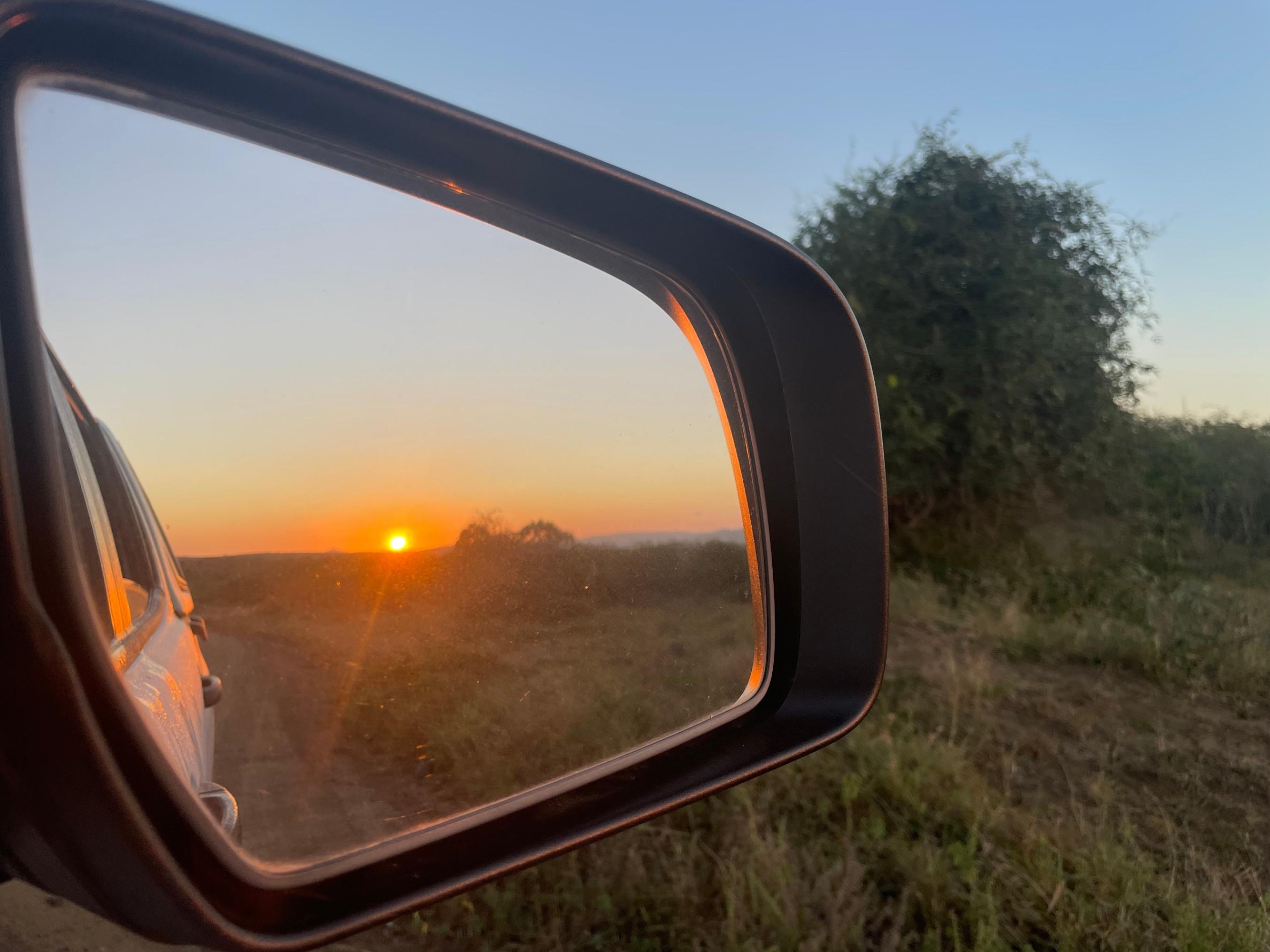
You climb out from under the sheet that kept you warm during the night, make your way outside barefoot, still wiping the sleep from your eyes, and have the only warm drink of the day: a cup of coffee. The world starts to light up around you, the sun begins to push its way over the bush, and for a few quiet minutes everything feels exactly as it should.
Soon, the only respite from the pressing heat and clawing humidity will be the shade of an acacia tree and, if you are lucky, a slight breeze to cool the sweat on your brow. But for now, it is still gentle. Still quiet. Still forgiving.
This is Zululand.
This is home.
This is where my soul comes to recharge.
Sandwiched between the N2 and the town of Nongoma, Hluhluwe-iMfolozi Park is an oasis of unspoilt nature in an otherwise densely populated part of the world. Situated almost slap-bang in the middle of Zululand, this landscape was once part of the hunting grounds associated with Shaka, King of the Zulus. The current Zulu monarch’s royal household is not far from the western boundary and, when you enter the park, you get a sense of what this place must have felt like long before tar roads, boundary fences and Google Maps started giving everyone opinions.
Large parts are still wilderness areas. No roads. No traffic. No picnic tables. No people leaning out of hatchbacks asking whether the lion sighting is “just around the corner”. Just wild land, carrying on as it has for thousands of years, completely uninterested in your itinerary. These sections were once protected as royal hunting grounds, places ordinary people were not permitted to enter, and I for one am grateful that large parts of them still remain wild today.
That is one of the things that makes Hluhluwe-iMfolozi so special. It still has a proper wilderness feel in places. Not the polished, manicured, “please enjoy your curated nature experience” kind of bush. Proper bush. The kind that reminds you very quickly that you are visiting, not supervising.
Hluhluwe-iMfolozi is also one of the great names in rhino conservation, deeply tied to Operation Rhino and the recovery of the southern white rhino. The place is steeped in history and, if you take the time to speak to someone with local knowledge, it soon becomes obvious just how special this piece of earth really is.
Having grown up in Zululand, it holds a special place in my heart. I regret not exploring it more earlier in my life, but that is how it goes. When something is close to home, you tend to think it will always be there waiting for you. Then you get older, hopefully slightly less stupid, and realise that some of the best places were sitting right under your nose the whole time.
I have fallen in love with this piece of paradise, and I hope to take you through some of what makes it such a remarkable place.
A quick lay of the land
Before we get into the actual trip, it is probably worth explaining what Hluhluwe-iMfolozi actually is, because this is not just another fenced-off piece of bush with a gate, a map and a few confused tourists in rental cars.
Hluhluwe-iMfolozi Park is one of the grand old names of African conservation. Proclaimed in 1895, it is widely regarded as Africa’s oldest proclaimed game reserve and covers roughly 96 000 hectares of proper Zululand bushveld. It is Big Five country, but more importantly, it is rhino country.
This is the place where Operation Rhino helped pull the southern white rhino back from the edge of extinction, which is quite something when you consider how casually we now talk about seeing rhino on a game drive. That did not happen by accident. People fought for that. Some probably with clipboards, some with rifles, and I imagine a few with a very strong sense of humour and not nearly enough sleep.
The park is basically made up of two main sections. Hluhluwe is the northern section: greener, hillier and home to Hilltop Camp, which sits up on a ridge with those sweeping “yes, this is why people come to Africa” views.
iMfolozi is the southern section: drier, more open in places, wilder in feel and, in my opinion, the bit that gets under your skin the fastest. The two sections are joined into one park, but they still feel different enough that you could almost treat them as siblings. Related, but definitely not the same person at the braai.
The Black and White iMfolozi rivers cross the iMfolozi section and eventually meet just outside the reserve’s south-eastern boundary before flowing towards the St Lucia system. The Hluhluwe River drains the northern section towards False Bay.
Rivers matter here. In dry times, they become highways, meeting points and, occasionally, the place where every animal in Zululand seems to have agreed to arrive at the same time while you are trying to eat a slightly warm sandwich and pretend the cheese is still fine.
Getting in, what it costs and where to stay
Most visitors enter through one of the main gates. Memorial Gate is normally used for the Hluhluwe side, while Nyalazi Gate is the popular access point for iMfolozi and Mpila Camp. Cengeni Gate on the south-western side can also be useful, depending on where you are coming from and how much faith you have in your GPS.
From Durban, you are looking at roughly three hours to the area, depending on traffic, roadworks, toilet stops, biltong stops and the inevitable debate about whether the GPS knows what it is doing. It probably does. You will question it anyway. This is tradition.
Gate times are seasonal and are strictly enforced, so do not arrive late and expect the boom gate to care about your excuses. The current published Ezemvelo information lists summer gate hours as 05:00 to 19:00 from October to March, and winter gate hours as 06:00 to 18:00 from April to September.
Always check before you travel, because few things are more humiliating than sleeping outside a game reserve gate because you treated time as a loose suggestion.
In terms of costs, this is still one of the more accessible Big Five destinations in South Africa, but it is not free, despite what your uncle who “used to know a guy at the gate” might suggest.
At the time of writing, the published Ezemvelo conservation fee for Hluhluwe-iMfolozi is R300 per adult per day and R150 per child under 12, with a discounted rate of R150 per person per day for South African and SADC residents who can prove it. Always check the latest tariffs before you go, because prices change and nothing ruins the start of a bush trip quite like doing maths at the gate while the people behind you judge your life choices.
Accommodation depends very much on what kind of bush experience you want.
Hilltop Camp, in the Hluhluwe section, is the more developed option. It has chalets, rondavels, a restaurant, bar and more of a classic rest-camp feel. This is the better choice if you want the bush, but still like the idea of someone else dealing with supper. No shame in that. We all have moments where we want nature, but not enough nature to wash our own dishes.
Mpila Camp, in the iMfolozi section, is far more rustic and is fully self-catering. It has chalets and safari tents, and the camp is unfenced, which means the wildlife does not always respect your personal space or your romantic ideas about sitting quietly outside with a glass of something cold.
Bring your own food, drinks, ice, firewood and common sense. The little shop may help you out with basics, but it is not where you want to be doing your main grocery shop unless your meal plan is “whatever is left next to the till”.
There are also bush lodges and wilderness trail options for those wanting something more remote. The iMfolozi Wilderness Trails are famous for a reason. Walking through this landscape changes how you see it. In a vehicle, you are a spectator. On foot, you become part of the menu. Or at least that is what your brain tells you the first time a twig snaps behind you.
For first-time visitors, I would suggest at least two nights, but three is better. One night is basically just arriving, unpacking, braaing, sleeping and then leaving in a huff because you “didn’t see much”.
This is not a zoo. The animals do not clock in at reception.
Give the place time. Drive slowly. Stop often. Sit quietly at viewpoints and water crossings. Accept that sometimes the best sighting of the day is not a lion on the road, but a fish eagle calling over the river while the sun drops behind the hills.
Also, summer in Zululand is not a joke. It can be brutally hot and humid, the kind of heat that makes you question your personality. Winter and the drier months are generally more comfortable for game viewing, with less vegetation and animals often coming down to water, but summer brings its own magic: green bush, dramatic skies, migrant birds and that thick, alive feeling that only Zululand can deliver.
So yes, Hluhluwe-iMfolozi is a Big Five reserve. Yes, you can see rhino, elephant, buffalo, lion and, if the bush gods are feeling generous, leopard. But that is not really why I keep wanting to go back.
I go back because it feels ancient.
Because it still has corners where the roads disappear and the wilderness carries on without caring whether you brought the right camera lens.
Because when you sit outside at Mpila after the generator goes off and the lions start calling in the dark, you remember very quickly that we are not nearly as important as we think we are.
Our first afternoon at Mpila
Since I started exploring this park properly, I have spent most of my time in the iMfolozi section. I have been on a walking safari, explored viewpoints and picnic spots, and stayed in bungalows, safari tents and bush lodges. I am also rather obsessed with sundowners, which is not a problem but rather a commitment to research, and I have compiled a list of my favourite spots for those as well.
I am by no means an expert, but that is not the point. If I can help you find the expert, or point you in the right direction, then I have already achieved something.
So, please join me on a trip around the iMfolozi section. We were joined by my folks and my brother for my 40th birthday trip and, having not been here for far too long, I thought I would share it with you. The links to the other sections are included in this post, so please have a look at those as well.
We arrived at about 3 in the afternoon, having gone through Nyalazi Gate and followed the tar road up to Mpila Camp. Game viewing was excellent on that first stretch. We saw rhino, elephant and buffalo within the first few kilometres, which is always a nice way for the bush to say, “Welcome back, try not to behave like an idiot.”
Crossing the Black iMfolozi means you are almost at Mpila. The road starts to snake up a hill almost immediately after the crossing and you can feel the temperature drop a little. Not enough to make you forget you are in Zululand, but enough to stop you from wondering whether your organs are being slow-cooked.
On arrival at Mpila, the camp looked well maintained and the little shop was quite well stocked. Wood, charcoal, ice and even some beverages were readily available. The units were neat and clean, and you probably will not want for much. All accommodation is self-catering, so be sure to bring the bulk of what you will need.
We went on a late-afternoon drive to check out some of the viewpoints and picnic spots, hoping to catch the last rays of the sun for a cool sundowner. The weather did not play along and we got back to camp before dark. Although it was winter, Mpila sits up on a hill, which gave us a few extra minutes of light and just enough time to pretend we had planned it that way.
What is a trip to the bush without a braai? We had a lovely braai and I got the best birthday “cake” ever: beers packed in a circle and surrounded by sticks of dry wors. It was beautiful. Not elegant, not traditional, and almost certainly not recommended by any dietician, but beautiful.
We were entertained by a herd of impala as well as an interesting encounter with a bushpig later that evening, which made Brody nearly wet himself.
A word of warning: bushpigs are dangerous, and the ones that are “tame” and used to humans are probably more so. Do not feed them, do not tease them and please do not try to touch them. A stern shooing will normally get them to scavenge somewhere else.
If that does not work, surrender the dignity and retreat. The bushpig has made its point.
The generator is switched off at 22:00, which means you had best be happy to sit in the dark after that. But it also allows you to savour the night sounds. We were treated to a symphony of lions roaring and hyenas calling. A spectacular end to the day.
Waking up on the second morning, with a true Zululand morning wrapped around us, was manna to my soul.
Practical note: entrance fees, gate hours and accommodation details change. Check Ezemvelo KZN Wildlife’s latest Hluhluwe-iMfolozi tariffs and booking pages before travelling.