From the field
Ngepi, a Jewel of the Okavango - Part one: Border posts, Hippo pools and a Broken Chair
The road to Ngepi rattled teeth, tested patience and introduced us to enough camel thorn folklore to make sitting in the shade feel like a poor life choice. After crossing into Namibia through Mohembo, we found cold beer, a cage in the Okavango, a hidden Hilux fuse box and one camping chair that had clearly reached its emotional limit.
23 November 2024
Ngepi, a Jewel on the Okavango
Part 1: Border posts, Hippo Pools and a Broken Chair
Our second stop on the Tiger Fishing Adventure was Ngepi Camp, just over the Namibian border and tucked into that watery, wild corner of the old Caprivi Strip. Technically we were in Namibia, but the place feels less like a country and more like a mood: river, sand, elephants, papyrus, heat, beer, dust and the faint possibility that something with teeth is watching you from the reeds.
We had come up through Botswana, past Tsodilo Hills and the Okavango Panhandle, then aimed for the Mohembo Border Post near Shakawe. The road getting there was, to put it politely, not the highlight reel. The tar had stretches so badly corrugated that the gravel shoulder next to the road started looking like the luxury option. Proper molar-rattling stuff. Not much in the way of game either, unless you count three men in a Hilux slowly losing their sense of humour.
One useful bit of bush wisdom came from the wise old man in the vehicle, who announced that there is a blood-sucking thing called a sand tampan that likes the loose, shaded sand under camel thorn trees. Not a fly, as I first remembered it, but a soft tick. Properly known as Ornithodoros savignyi, if you want to sound clever while also ruining everyone’s lunch.
The idea is simple and horrible. Animals rest in the deep shade of camel thorns, the sand below becomes a regular stop for warm-blooded traffic, and the tampans sit there waiting like tiny biological landmines. When something suitable arrives, they feed. They do not politely introduce themselves, they just get on with the job. From what I can gather, they do not burrow into your skin like the horror story version my memory had built over the years, but they do cut, feed and can leave you with a reaction that makes you question every decision that led you to sitting in sand.
The lesson was clear enough: keep your shoes on, do not flop down under camel thorns like a kudu with no responsibilities, and maybe treat any inviting patch of Kalahari shade with the same suspicion you would give a border official who says, “This will only take five minutes.”
That said, the camel thorn trees along that stretch are magnificent. Big, sculptural, stubborn things, standing in that dry country as if someone forgot to tell them that life there is meant to be difficult.
The wise old man was not finished with camel thorn warnings either. Apparently these trees also come with their own lightning story. The version we were given involved rats nesting inside old hollows, a build-up of gases and lightning turning the whole thing into a natural bushveld firecracker.
Now, I have not found enough proof to confidently publish the methane part as gospel, and it sounds exactly like the kind of story that improves every time it is told around a fire. What does seem more believable is this: camel thorns are known as proper Kalahari lightning targets, and old trees can hold dry hollows, bark, abandoned nests, bird material and all sorts of small-creature architecture. Add summer lightning to that lot and you do not need a degree in physics to decide that standing underneath one during a storm is probably not the smartest way to prove your bravery.
So, between the sand tampans, possible rat nests, thorny branches, shade-loving animals and alleged lightning bombs, the camel thorn had now officially moved from “beautiful tree” to “admire respectfully from a sensible distance”. Not really, we still find these as our favourite tree to stop under, we just keep our shoes on!
Before crossing into Namibia, we found ourselves near Mohembo and Shakawe, where the Okavango River Bridge, also known as the Mohembo Bridge, crosses the river. We decided to drive over it, mostly because it was there and because, on a trip like this, doing things purely so that you can later say you did them is completely acceptable. It is an impressive piece of engineering, with those elephant-tusk style pylons rising above the river. After days of dust and corrugations, suddenly there it was: modern, clean, dramatic and stretching over one of Africa's great rivers.
We had been in Shakawe the day before searching for fuses, as mentioned in the previous article, so the area was not entirely new to us. The temptation to buy more fuses, just in case, was strong. We still had not worked out which fuse needed changing, or even where Toyota had decided to hide the Hilux's fuse box. I was researching this at every possible signal point, which is a glamorous way of saying I was standing next to the bakkie, sweating, swearing softly and watching YouTube clips that loaded in three-second bursts.
The border itself was quiet, almost deserted. There are border posts where the whole thing feels like a test of your patience and moral fibre. This was not one of those. We were crossing into Namibia for the next stretch of the trip, and the focus was shifting from tiger fishing to game viewing, exploring and generally pretending that the fishing had not already humbled us.
Soon after clearing customs on the Namibian side, the landscape changed. We were effectively entering the Mahango side of Bwabwata National Park, which means that if luck is in a good mood, you can start seeing game almost immediately. In our case, we were greeted by elephants trying to find anything green in a landscape that looked like it had been baked twice and served without sauce.
Friendly reminder: if you pass through the park section, expect to deal with park fees when exiting. We stopped at the gate in the brutal midday glare, stepped out onto sand hot enough to make your toes reconsider their life choices, and collectively reached the same conclusion: this heat required a cold beer.
We chose not to do a proper drive through Mahango, although it is absolutely the kind of place that deserves time if your schedule allows. We decided instead to head for the Divundu and Bagani area to stock up for the next two nights.
Naturally, because Africa likes to keep you humble, there was no electricity when we arrived. No power meant no ice and no properly cold beer, which is not a small thing when the sun is trying to turn you into biltong. The silver lining was a well-stocked supermarket, where we could get most of what we needed. Being in Namibia also meant we suddenly had access to one of my all-time favourite road-trip foods: fresh Brötchen with cold meats. That German colonial influence may come with a complicated history, but it did leave behind some excellent bread. As someone with German blood in the system, I am not going to pretend that a fresh Brötchen does not speak directly to my soul.
This is also where the B8, the Rundu to Divundu road, becomes important. Our next leg would eventually take us west along that route, but for now we turned back south towards Ngepi, loaded with Tafel Lager, groceries, wood and hope.
The Okavango in this area is not just scenery. It is the whole story. Life collects along the river: people, birds, animals, lodges, boats, fishermen, crocodiles, hippos and overlanders who have driven too far and now need a shower. The river pulls everything towards it.
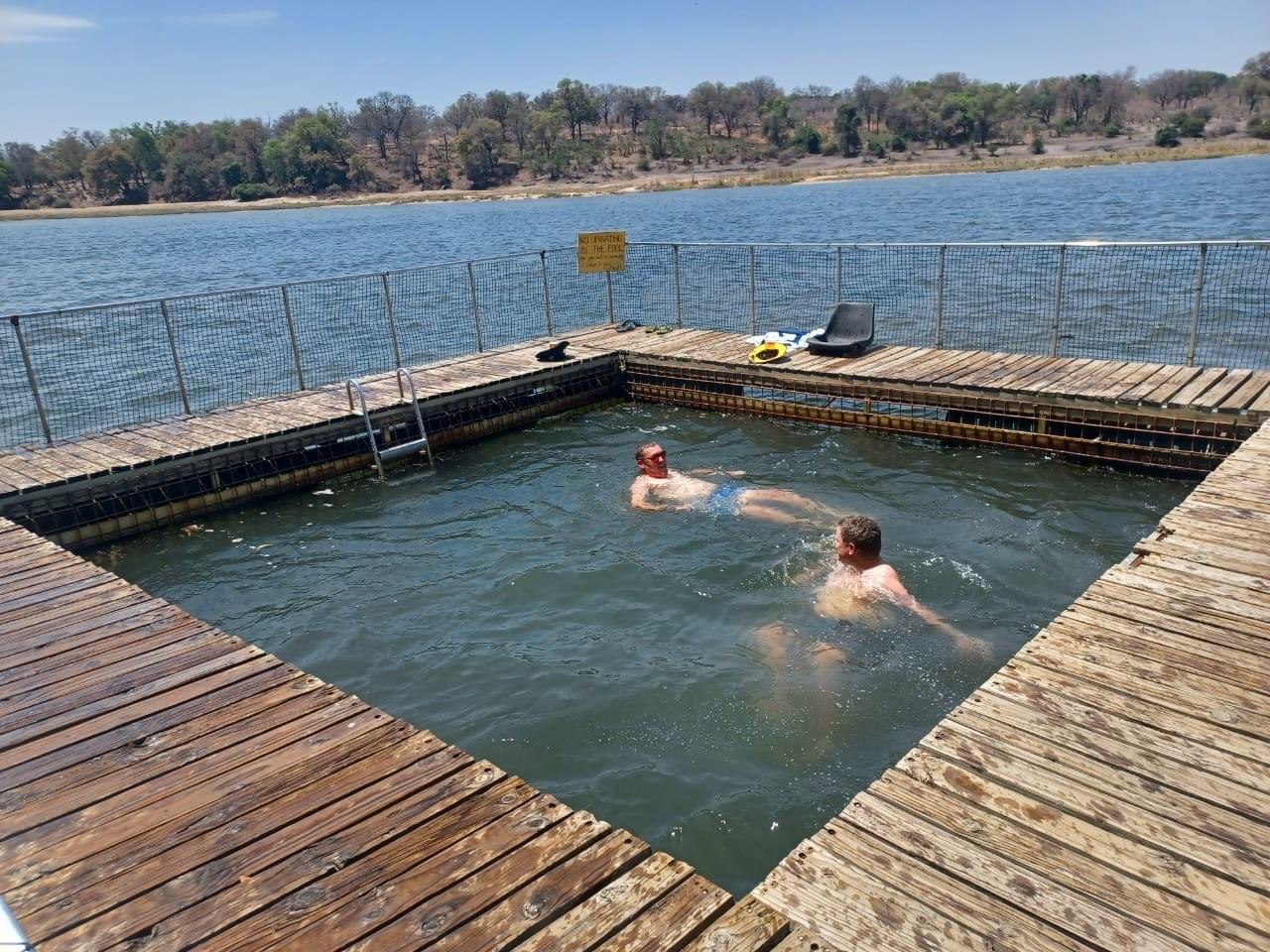
Ngepi is famous for two things: its hippo pool and its bathrooms. The hippo pool is basically a cage in the river, which sounds ridiculous until you are standing there in the heat, staring at cool water flowing through it. It gives you the feeling of swimming in the Okavango without having to personally negotiate with crocodiles or hippos, which I consider a major design improvement.
Turning off the tar, we stopped to buy firewood and drop tyre pressures again. Sandy tracks and hard tyres are not friends. If you want your vehicle to behave like a stubborn shopping trolley, keep the tyres pumped to road pressure. If you want to get to camp with some dignity intact, let some air out.
The drive in immediately set the tone. There were signs gently suggesting that Toyota drivers take one route, while other vehicles might prefer the easier, flatter option. I enjoyed this perhaps more than I should have. We bounced along, feeling suitably superior for about four minutes, then arrived at reception dusty, sweaty and ready to be impressed.
Reception sits right off the bar, which tells you a lot about the priorities of the place. The reception area itself is small, the bar is not. Covered in stickers of people who have visited, photos, caps, hats and grafiti...this Bar can tell a few stories! This is usually a good sign. The staff were friendly and helpful, and there was a restaurant with a daily set menu, which is very handy if you arrive late, broken, hungry and not in the mood to produce a meal from a cooler box while pretending to be cheerful.
A quick stroll towards the river revealed the real magic: a deck with hammocks, couches and one of those views that makes you stop talking for a moment. Across the water, the Okavango moved with quiet confidence. To the left was the famous pool. Setting up camp in midday heat was clearly going to require both a swim and a visit to the bar. Possibly in that order. Possibly not.
Our campsite was right on the river, which felt like winning something. It was basic, shady and exactly what we wanted. There was a small patch of green lawn with a polite sign asking us to put tents on the sand and not on the grass. Very private-school energy. Namibia was clearly saying: you may be in the wild, but please do not behave like animals.
The ablutions were close by, with a choice between more normal brick-and-mortar options and the famous open-air versions, including a shower rose hanging from a tree inside a little boma. This is the kind of thing that sounds odd until you use it, then suddenly every bathroom with a ceiling feels slightly overdone.
We set up camp, carefully avoiding the precious lawn, then headed for the pool. We told ourselves this was necessary so that I could cool my head and think clearly about the still unresolved fuse-box problem. This was, of course, a lie. We wanted to sit in the river with a cold Hansa draft and feel smug about life.
The pool deserves its own paragraph. You walk down the jetty and there it is: a square cage in the Okavango, with clear, cool river water pushing through it. No loungers, no pool noodles, no cocktails with umbrellas. Just a cage, a river and the knowledge that outside the cage are things that would not feel bad about eating you.
You climb in, grab the side and just float there. "Hier chill ich jetzt im Rivier und fühl fokol". With an ice-cold Hansa in hand, life could honestly not have been much better. We laughed, chatted about dinner, agreed that we should definitely go fishing the next day, and delayed the fuse issue for as long as dignity would allow.
Eventually, with heads cooled and beers finished, it was time to stop procrastinating. The 12V problem had to be sorted. Armed with half-remembered YouTube wisdom and a voice note from a Toyota salesman back in South Africa, I folded myself into the passenger footwell and began dismantling the cubby to find the hidden fuse box.
Toyota, if anyone from your design department is reading this, there has to be an easier place for it. Somewhere accessible to a human spine would be lovely.
After some grunting, a bit of neck pain and only a moderate amount of internal panic, the culprit fuse was found, removed and replaced. The 12V system came back to life. I was rewarded with a pat on the back from the other two, and Karl immediately declared that this sort of technical victory deserved another beer. I chose not to argue with the man.
Dinner was lamb chops, Brötchen and some pickled beetroot salad for vitamins, or at least for the illusion of vitamins. The camel thorn wood crackled away, the sun slipped down over the Okavango, and the river turned gold in that way that makes you briefly forget emails, traffic, broken fuses and every other nonsense thing waiting for you back home.
That is called living.
Unfortunately, my belief that the repairs were done for the day was short-lived. Just as I sat down after dinner, my camping chair decided that it had also had enough of the trip and split along one corner. I was folded into it like a drunk pretzel while the other two enjoyed what was, apparently, the best entertainment of the evening.
So there I was, sitting on the ground after dinner, carefully making sure there was no camel thorn tree nearby because by this point I was not taking any chances with parasites, insects, rats, methane or lightning. I then made what was possibly the best use I had made of fishing line on the whole trip and sewed the corner of the chair back together with braid.
Would it hold for the rest of the trip? Probably not.
Did I immediately trust it with my full body weight again? Obviously.
Our German neighbours, actual Germans from Europe, arrived that night and set up a rooftop tent on a rented Ford. They made pasta on a gas cooker and went about their evening in that efficient, quiet way that makes you feel like your own campsite may be part of a travelling circus.
I sometimes wonder what they thought of the lot next door. Three South Africans speaking Springbokdeutsch, drinking beer, cooking chops over camel thorn, one man sitting on the ground sewing a camping chair with fishing braid, and everyone acting like this was completely normal.
Must be one of the stories they tell back home.
Tomorrow, the river would get its turn properly. Tigerfish, honey badgers, strange bathrooms and one of the best reminders of the whole trip: sometimes fishing is not really about the fish.