
From the field
Ngepi, a Jewel of the Okavango - Part two: Honey Badgers, Tiger Fish and Toilets with a View
A stolen braai broodjie, a suspected honey badger and a morning on the Okavango set the tone for our second day at Ngepi. The tigerfish were mostly unimpressed, but between elephants on the bank, toilets with a view, carmine bee-eaters and one heroic lodge-deck cast, the river still delivered exactly what we needed.
23 November 2024
Ngepi, a Jewel on the Okavango
Part 2: Honey Badgers, Tiger fish and Toilets with a View
The next morning, we woke to find the braai grid dragged halfway towards the neighbour's camp and a half-eaten braai broodjie lying under the table. Now, Karl and I were not exactly refusing a good time on this trip, but we had definitely not been part of that particular party. The prime suspect was a honey badger.
The little criminal had helped himself to leftovers, including the final chop that had been cooling in the braai grid. I have always admired honey badgers. Not enough to invite one into camp, but enough to respect the sheer confidence. They open things, break into things, drag things away and generally behave like small, angry mechanics with criminal records.
Fishing was on the agenda, so we climbed onto the boat for the morning session. Drifting along the river, my dad pointed out the old 32 Battalion site on the opposite bank. It was a reminder that this peaceful stretch of river has carried a lot more history than a tourist brochure will ever properly explain. Nature has done what nature does, slowly taking back the edges. Animals have returned, trees have grown, and the bush has softened the scars.
On the positive side, we watched elephants, waterbuck and other antelope while fishing for tigerfish. That is not a bad way to spend a morning, even if the fish are treating your lure with the same enthusiasm normally reserved for load-shedding notifications.
I badly wanted to land a tiger. You do not drive all that way, talk that much nonsense and sweat that heavily just to come home with stories about how close you were. Unfortunately, this was not my day. Heinz managed a decent fish, which was both good for the trip and irritating for my ego.
Lunch followed, then some time to read, relax and deal with the modern overlander's most boring emergency: roaming bundles. This has become easier over the years, but crossing borders still has a way of turning your phone into a small expensive brick. One bundle activates in one country, then sulks in the next. Tedious, but necessary. You never know what crisis is unfolding back home, and apparently disappearing into the bush does not absolve you from admin.
Before the afternoon session, I need to talk about the bathrooms. Ngepi's toilets and showers are not just facilities, they are attractions. They are part art installation, part bush humour and part engineering dare. The best time to explore them is around lunch, when many campsites are empty and you are less likely to wander up to someone's private loo like a confused bathroom tourist.
Sherise is a bath person, so I had to send her photos of a bath overlooking the Okavango. Imgaine lying in the tub after a long day on the road, watching the mighty Okavango just wash the long day away...not Kak. There is also a loo with a view, although that description does not quite do it justice. Sitting there, looking out across the river, you start to wonder why we ever accepted bathrooms with blank walls and extractor fans. It was probably one of my top five bowel movements, and I say that with the seriousness it deserves.
From what I have seen since, Ngepi keeps adding new bathroom oddities, including elevated options that let you look even further across the river. Wonderful, unless you have vertigo, in which case maybe stick to something closer to the ground and less emotionally challenging.
The afternoon was spent fishing again. The highlight, and possibly the most accurate summary of our fishing performance, was Karl casting his lure onto the deck of one of the lodges we were passing. This came as a surprise to the patrons enjoying a cold drink, and probably to Karl as well.
Luckily, nobody was injured. The lure was recovered, plopped back into the water and reeled in with whatever remained of Karl's dignity.
There are some impressive places along that river: floating chalets, big decks, houseboats and lodge setups that make you wonder whether your own camp chair has been underachieving. Who does not like a big deck? Everywhere you look, there is another little pocket of comfort surrounded by proper wilderness.
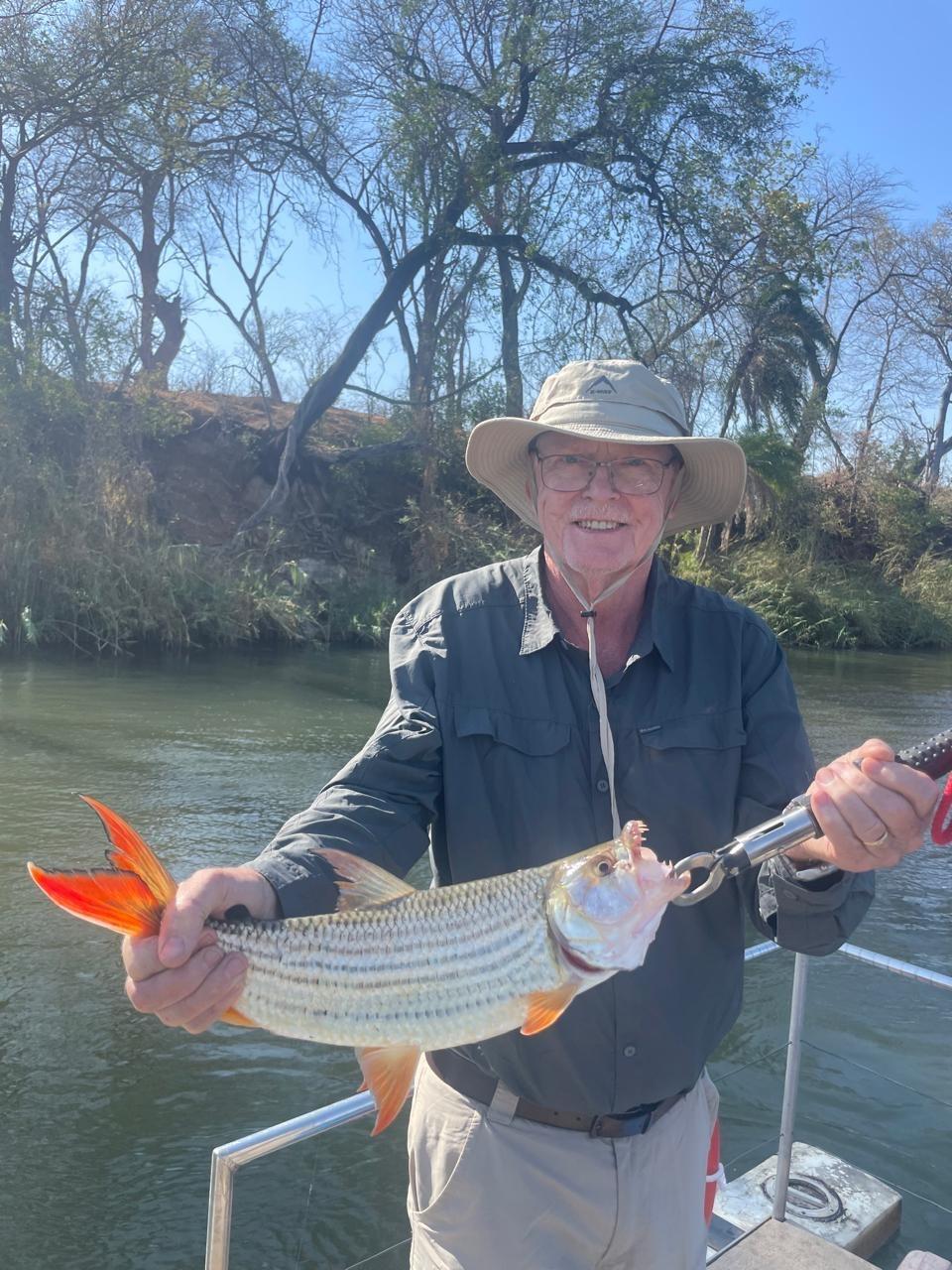
The fishing itself was still not great although Karl opened his Tiger count with a nice little Tiger. We did see carmine bee-eaters, which were a proper highlight. At the time, we thought it was impressive. Later in the trip we would see them in numbers that made this first sighting look like the warm-up act, but that is a story for another day.
We returned to camp slightly disappointed in the fishing, but completely content with everything else. Ngepi had done what the best places do: it had taken our original plan and made it almost irrelevant. Yes, we had come to fish, but we found ourselves talking more about the river, the campsite, the pool, the bathrooms, the elephants and that simple pleasure of sitting under trees at the end of a long day.
That evening we sat around the fire and had one of those deep travel conversations that only happen when people are tired, fed and staring into flames. What was amazing? What would we do differently? Would we come back?
Definitely.
Although next time, maybe we leave the fishing rods behind.
That might be the real lesson. Fishing is not always about the fish. Sometimes it is about the places it drags you to, the people you sit with afterwards, the stories that get better with every retelling, and the quiet stretch of river that somehow makes the whole detour feel necessary.
Tomorrow we would head out again, continuing towards Katima Mulilo and eventually Chobe.
But for now, one nightcap, one last look at the fire, and then bed.